Eyeliner Aftercare

Welcome to our eyeliner aftercare page. We have designed this page to help our clients better understand the healing process and to address common client questions and concerns. Having the right expectations, following instructions, and understanding the healing process, will help you achieve your best results.
2. Eyeliner Aftercare Instructions
727-213-8811 Call or Text
Mon-Sat 10-5p
What to expect

Understanding the healing process helps set realistic expectations and reduce dissatisfaction. Your 6 weeks of healing will go through several normal stages before revealing your final 1st session results.
What is normal?
- Darker color initially.
- Mild swelling, redness, and tenderness the first 1–3 days.
- Itchiness (do not scratch).
- Flaking/Peeling.
- Ghosting - Color disappearing after flaking/peeling.
- Wide variety of results for the 1st session, including healing light, like it didn't take, patchiness, and some unevenness.
- Needing the 6-week touch-up.
- Less predictable healing than body tattoos.
Possible Results (1st Session)
- Healed ideally. (Unusual)
- Healed Light to very light. (Normal)
- Pigment disappeared/Didn't take. (Fairly Common)
- Too dark. (Rare)
- Some patchiness (Common)
- Some unevenness (Common)
Don't worry. These are normal results for the first session since your brows are trying to push out a foreign pigment. Basically your first session is a little unpredictable and the touch-up will usually give better and more predictable results since your skin has acclimated to the pigment.
6-Week Touch-Up
Why the Touch-Up is Recommended:
- Pigment Acclimation - In general, you can expect better and more predictable results with the touch-up because your skin has acclimated to the pigment and is less likely to try to reject the pigment.
- Personalized Adjustments - Everybody heals differently based on their skin type. Our techs can take a look and see how your eyeliner healed and make precise adjustments for optimal pigment retention, shape, color, and symmetry.
- Extended Life - The touch-up significantly extends the life of your semi-permanent makeup by building a stronger foundation of pigment.
eyeliner aftercare Instructions

How to care for your eyeliner:
The better you follow these instructions during the full 6-week healing phase, the more even, vibrant, and long-lasting your results will be. Healing is a process—eyeliner goes through stages (darkening, scabbing/flaking, fading, then settling). Do not panic. These are normal.
1. Clean
The Cleaning Routine
- Frequency: Clean the area twice a day (once in the morning and once in the evening).
- Step 1: Wash your hands thoroughly with soap and water before touching your face.
- Step 2: Dampen a clean cotton pad with distilled water.
- Step 3: Gently dab the eyeliner area. Do not rub, scrub, or wipe.
Important guidelines
- No Harsh Cleansers: Avoid soap, facial cleansers, or makeup removers on the treated area during the healing process.
- Hands Off: Minimize touching your eyes throughout the day. Keeping the area clean and untouched is the best way to keep bacteria away and prevent infection.
2. Moisturize
Keeping your permanent eyeliner properly hydrated is just as important as keeping it clean. Proper moisture prevents heavy scabbing and ensures the pigment heals evenly.
How to Apply
Step 1: After cleaning, gently pat the area completely dry with a clean tissue or cotton pad.
Step 2: Dispense a small amount of Cetaphil (or your recommended aftercare cream).
Step 3: Use a clean cotton swab (Q-tip) to apply a very thin layer over the eyeliner.
Why This Step Matters
Promotes Optimal Healing: Keeping the area moist prevents the skin from drying out and cracking, which helps lock in the pigment.
Accelerates Recovery: Your specialized aftercare moisturizer is packed with essential vitamins and minerals designed to speed up the skin's natural healing process.
Pro-Tip: Less is more! A "thin layer" means the skin should look slightly shiny, not heavily coated or gloppy. Over-applying moisturizer can suffocate the skin and pull pigment out.
3. Hydrate
Drink plenty of water throughout the healing process. Internal hydration keeps your skin supple, reduces inflammation, and directly accelerates the cellular regeneration needed to lock in your new pigment.
Pro Tip: Aim for your standard 8 glasses of water a day to give your immune system the boost it needs."
Optional: Cold Compress
Some slight swelling and redness is normal post-procedure. Apply a cold compress (like a clean cloth soaked in cold water) gently for 10 minutes to reduce swelling, but avoid putting pressure.
Do's for eyeliner aftercare
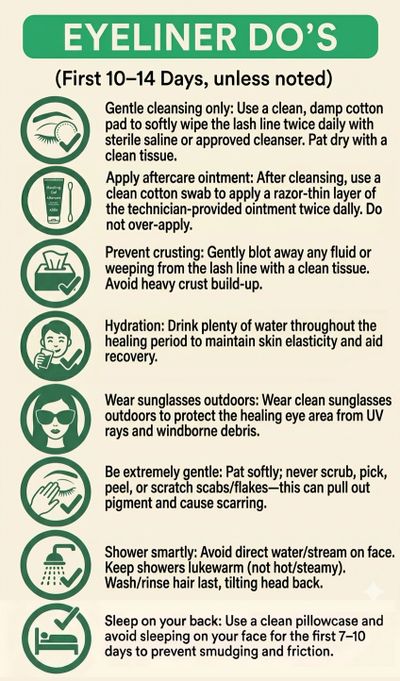
1. Gentle Cleansing Only
Use a clean, damp cotton pad to softly wipe the lash line twice daily with sterile saline or approved cleanser. Pat dry with a clean tissue.
- Why it matters: The eye area is incredibly sensitive and highly prone to infection right after a procedure. Skipping cleansing allows bacteria to build up, but aggressive rubbing will dislodge the freshly implanted pigment.
- Pro-Tip: Always use a patting or sweeping motion rather than rubbing back and forth. Ensure the water or saline is lukewarm—never hot.
2. Moisturizing
Apply a razor-thin layer of your approved aftercare ointment.
- Why it matters: Externally, keeping the skin balanced—not bone dry, but not suffocated by heavy products—allows the epidermal layers to repair smoothly.
- Pro-Tip: When applying your post-care ointment, less is always more. A layer that is too thick will suffocate the skin, trap bacteria, and cause the pigment to blur or reject. Aim for a tiny, barely-visible sheen (about the size of half a grain of rice for both eyes) applied with a clean cotton swab.
3. Prevent Crusting
Gently blot away any fluid or weeping from the lash line with a clean tissue. Avoid heavy crust build-up.
- Why it matters: In the first 24–48 hours, the skin exuded lymphatic fluid (plasma). If left to dry on the skin, this fluid hardens into thick, heavy scabs. When those heavy scabs eventually fall off, they take the eyeliner pigment with them, leaving gaps.
- Pro-Tip: Blot gently every few hours on the first day. Think of it as "press and lift" with a clean, dry tissue to keep the area clean and dry without disturbing the skin.
4. Hydrate
Drink plenty of water throughout the healing process
- Why it matters: Healthy, hydrated skin heals significantly faster and retains pigment much better than dry, compromised skin. Drinking water flushes out toxins and keeps your skin cells plump, which aids the recovery process from the inside out.
- Pro-Tip: Aim for your standard 8 glasses of water a day to give your immune system the boost it needs.
5. Wear Sunglasses Outdoors
Wear clean sunglasses outdoors to protect the healing eye area from UV rays and windborne debris.
- Why it matters: UV rays degrade tattoo pigment rapidly, especially when the skin is broken and vulnerable. Furthermore, a sudden gust of wind can blow dust, pollen, or pet dander directly into your healing eyeliner, risking a painful infection.
- Pro-Tip: Clean the frames of your sunglasses with an alcohol wipe before putting them on, as sunglasses frequently harbor bacteria along the rims.
6. Be Extremely Gentle
Pat softly; never scrub, pick, peel, or scratch scabs/flakes—this can pull out pigment and cause scarring.
- Why it matters: Flaking is a completely normal part of the epidermal regeneration process. However, if you pick a flake that isn't ready to drop off naturally, you are tearing live tissue. This creates a secondary wound, pulling out the ink and potentially causing permanent scarring.
- Pro-Tip: If the itching becomes bothersome, never scratch. Instead, gently tap around the eyebrow or cheekbone area to distract the nerves, or apply a tiny, approved amount of aftercare ointment to soothe the dryness.
7. Shower Smartly
Avoid direct water/stream on face. Keep showers lukewarm (not hot/steamy). Wash/rinse hair last, tilting head back.
- Why it matters: Steam opens up your pores and softens the healing skin, making the pigment expand or wash out entirely. Running water hitting your face directly applies too much pressure to the delicate lash line.
- Pro-Tip: Keep your showers short (under 10 minutes) and leave the bathroom door cracked to prevent steam build-up. Wash your hair at the very end of your shower by fully tilting your head backward under the faucet, like at a salon sink.
8. Sleep on Your Back
Use a clean pillowcase and avoid sleeping on your face for the first 7–10 days to prevent smudging and friction.
- Why it matters: Side or stomach sleeping smashes the eyes into the pillow. This creates friction that can prematurely peel healing skin and introduces bacteria from the pillowcase directly into the open wound.
- Pro-Tip: Switch to a fresh silk or satin pillowcase before your appointment (it minimizes friction if you do accidentally roll over). Prop yourself up with a travel neck pillow to help force your body to stay securely on your back.
9. Attend Your 6-Week Touch-Up
This is essential for perfecting shape, density, and color after full healing. Touching up too early (before 6 weeks) risks damaging skin and causing uneven/two-toned results.
- Why it matters: Permanent makeup is a two-step process. Everyone's skin retains pigment differently; during the first session, your artist is intentionally conservative to see how your skin heals. The touch-up is where gaps are filled, symmetry is perfected, and longevity is locked in.
- Pro-Tip: Do not panic if your eyeliner looks too light or "patchy" around week 3 or 4. The skin goes through a "ghosting" phase where the pigment is temporarily hidden by new skin cells before resurfacing. The 6-week mark is the safest time to accurately assess and fix the final look.
Don'ts for eyeliner aftercare
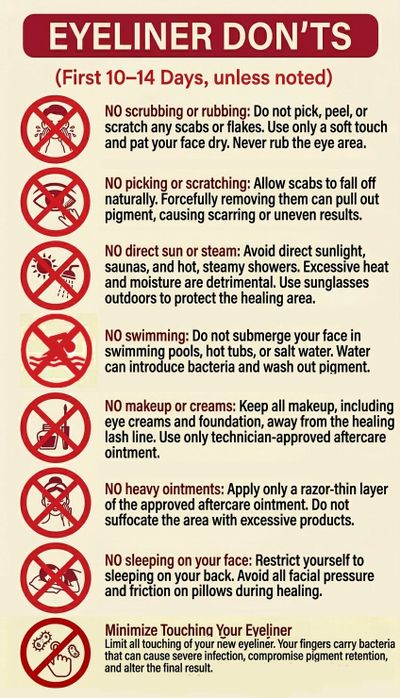
1. NO Scrubbing or Rubbing
Do not pick, peel, or scratch any scabs or flakes. Use only a soft touch and pat your face dry. Never rub the eye area.
- Why it matters: The skin around your eyes is exceptionally thin and delicate, and it is undergoing a profound healing process after your procedure. Rubbing or friction—whether from a towel, your fingers, or aggressive washing—will prematurely dislodge the microscopic layers of healing skin. This completely disrupts the uniform settling of the pigment, leading to patchy results.
- Pro-Tip: When drying your face after a shower or cleansing, use a clean, disposable paper towel or tissue instead of a cloth bath towel (which can harbor bacteria) and press it gently to the skin without moving it side-to-side.
2. NO Picking or Scratching
- Why it matters: As your eyeliner heals, it is completely normal to experience light flaking or tight, dry skin. However, these flakes are still anchored to the deeper dermal layers where the pigment lives. If you pick a flake before it is ready to shed naturally, you tear the skin and pull the color right out with it, creating a permanent blank spot or a scar.
- Pro-Tip: If the area becomes intensely itchy, do not scratch. Instead, take a clean cotton swab, apply a microscopic layer of your approved aftercare ointment to soothe the dryness, or gently tap the surrounding bone area to trick the nerve endings.
3. NO Direct Sun, Tanning Beds, or Steam
- Why it matters: Excessive heat and steam expand your blood vessels and open up your pores. When pores open significantly during the early stages of healing, it can cause the freshly implanted eyeliner pigment to blur, migrate, or wash out entirely. Furthermore, UV rays from direct sunlight degrade fresh tattoo pigment rapidly, causing premature fading before the skin has even finished closing.
- Pro-Tip: Keep your showers brief (under 10 minutes), use lukewarm water, and keep the bathroom door cracked or the exhaust fan on to minimize any humidity build-up.
4. NO Swimming or Excessive Sweating
- Why it matters: For the first two weeks, your eyeliner is essentially an open, healing wound. Swimming pools and hot tubs—even heavily chlorinated ones—are breeding grounds for bacteria, posing a massive risk for severe eye infections. Additionally, prolonged submersion in water (including ocean saltwater) will saturate the healing skin, softening it to the point where the pigment can dissolve and lift away.
- Pro-Tip: Tie your hair up securely and opt for low-impact, dry workouts or activities during the first 10–14 days so you aren't tempted to cool off in the water.
5. NO Makeup or Creams
Keep all makeup, including eye creams and foundation, away from the healing lash line. Use only technician-approved aftercare ointment.
- Why it matters: Applying mascara, eyeliner, eyeshadow, or heavy concealer introduces foreign chemicals and bacteria directly into the healing lash line. Even more dangerous is the removal process: makeup removers and oils are designed to break down products, and they will easily break down and pull out your fresh eyeliner pigment.
- Pro-Tip: Purchase a brand-new tube of mascara and a clean eyeliner pencil to use after your 14-day healing window is completely closed. Old makeup tubes are highly prone to bacterial contamination, and using them on newly healed skin can trigger an adverse reaction.
6. NO Heavy Ointments
Apply only a razor-thin layer of the approved aftercare ointment. Do not suffocate the area with excessive products.
- Why it matters: While keeping the area balanced is important, caking on heavy amounts of ointment creates an airtight barrier that completely suffocates the skin. Your skin needs oxygen to repair itself. Over-applying products traps moisture and body heat underneath, which softens the healing tissue and causes the eyeliner to blur, pool, or reject entirely.
- Pro-Tip: Always remember that "less is more." Use a clean cotton swab to apply a tiny sheen that is barely visible to the eye—about half the size of a grain of rice is more than enough for both eyes combined.
7. Minimize Touching Your Eyeliner
Limit all touching of your new eyeliner. Your fingers carry bacteria that can cause severe infection, compromise pigment retention, and alter the final result. Only touch the area with a clean cotton swab for aftercare applications.
- Why it matters: Your hands come into contact with countless surfaces throughout the day, making your fingertips a primary vehicle for bacteria, oils, and microscopic debris. Because a fresh permanent makeup procedure leaves the skin temporarily open and vulnerable, touching the eye area with unwashed hands dramatically increases the risk of an infection. Additionally, absentmindedly rubbing or picking at the area while checking on the healing progress can inadvertently lift the delicate scabs early, causing the color to heal unevenly.
- Pro-Tip: If you absolutely must touch your face near your eyes, wash your hands thoroughly with antibacterial soap and warm water first. For all ointment applications or gentle blotting, rely entirely on sterile cotton swabs or clean tissues rather than your fingers to keep the area completely pristine.
Stages of Eyeliner Healing

Phase 1: The First 24 to 48 Hours (The Fresh Phase)
- What to Expect: Your eyeliner will appear significantly darker, thicker, and sharper than your final healed result. Mild swelling, redness, and a tender sensation similar to a light sunburn are completely normal.
- Why It Happens: The pigment is currently sitting in both the top layer of skin (epidermis) and the target layer beneath it (dermis). Because it is completely exposed on the surface, it looks intense and bold. The needle micro-injuries trigger your body's natural inflammatory response. Blood flow increases to the area to deliver healing cells, which causes temporary swelling and redness, while the release of lymphatic fluid (plasma) can create a weeping effect as the skin attempts to close the micro-channels.
- Your Main Goal: Keep the area clean and calm. Focus on gently blotting away any fluid to prevent heavy crust from forming.
Phase 2: Days 3 to 7 (The Flaking Phase)
- What to Expect: The top layers of skin will begin to tighten, dry out, and flake off. You may notice tiny pieces of pigment shedding—this is a normal part of the skin’s renewal process. Your eyeliner may look uneven or patchy during this stage.
- Why It Happens: Your body is rapidly producing brand-new skin cells underneath the treated area to repair the barrier. As these new cells push upward, the old, damaged outermost layer of skin dries out and sheds. Because the flakes drop off in irregular pieces rather than all at once, the eyeliner will temporarily look uneven. The pigment trapped in that shedding top layer of skin is what you see coming off, which is entirely expected.
- Your Main Goal: Protect the skin from friction. Let all flakes drop off naturally without picking or scratching them.
Phase 3: Days 8 to 14 (The Resurfacing Phase)
- What to Expect: Once the flaking finishes, your eyeliner might look very light, slightly milky, or as if the color disappeared completely. This is called the "ghosting" phase. The pigment will gradually resurface and deepen over the coming weeks as the skin fully matures.
- Why It Happens: The newly formed skin cells on the surface are fresh, thick, and opaque. This acts like a sheet of frosted glass over the settled pigment in the dermis, temporarily hiding it from view and making it look too light or faded. Over the next 3 to 4 weeks, these new skin cells will mature, flatten, and become translucent. As the tissue settles and clarifies, the underlying permanent makeup pigment becomes visible again, revealing its true color and crispness just in time for your 6-week touch-up.
- Your Main Goal: Maintain basic hygiene and internal hydration while waiting for your upcoming touch-up session to perfect the final look.
Phase 4: Week 6 (The Touch-Up)
- What to Expect: Your eyeliner has fully settled, and the true color and shape are locked in. You will return for your mandatory 6-week touch-up appointment to fill in any minor gaps, adjust the thickness if desired, and perfect the overall uniformity. (Note that your first session may have healed very light or disappeared. Don't worry. This is common for the first session since the skin wants to kick out the foreign pigment. They touch-up normally produces better results as the skin has acclimated to the pigment and will be retained by the skin better.)
- Why It Happens: Permanent makeup is a layered procedure. Everyone's skin rejects and retains pigment differently based on their immune system, skin type, and lifestyle. The first session lays the foundation; the second session locks it in for longevity. Attempting to touch up the eyeliner any earlier than 6 weeks can cause severe skin trauma, scarring, and hyperpigmentation because the deep tissue layers are still fragile. Waiting a full 6 weeks ensures the skin is completely structurally sound and capable of safely holding the new layer of pigment.
- Your Main Goal: Your tech will look to see how the 1st session healed and make adjustments to get your eyeliner closer to the desired result.
Common eyeliner concerns
Dark/Intense Initial Color
When you look in the mirror during the first 3 days after your procedure, your eyeliner will look much darker, thicker, and sharper than the final result you discussed with your artist. Take a deep breath! This is a mandatory phase of the healing process, and the color will soften by 30% to 50% once healed.
Why Does It Look So Intense Right Now?
- Oxidization: The pigment used in permanent makeup contains iron oxides or organic compounds. When these pigments are freshly placed into the skin, they are exposed to the oxygen in the air. This causes the pigment to oxidize and turn very dark, much like an apple turning brown after you slice it.
- Pigment Sitting on Top: Right now, a small amount of excess pigment is still sitting in the very top layer of your skin (the epidermis). This excess will naturally flake away over the first week.
- Minor Swelling: The skin is slightly swollen and contracted, which can push the eyeliner lines closer together, making the liner appear thicker and bolder than it actually is.
What You Need to Do
- 🚫Do NOT try to wash it out: Do not scrub, use cleansers, or try to lighten the pigment. This will cause scarring or patchy healing.
- ✅ Wait for the flake: Between days 4 and 7, this dark top layer will naturally flake off, revealing a much softer, perfectly blended, natural-looking color underneath.
💡 The Golden Rule: Judge your eyeliner at Week 4, never on Day 2! The final color is a beautiful, soft combination of the pigment and your skin's natural undertones.
Soreness/Swelling/Redness/Bruising/Pain
Because the skin around the eyes is incredibly delicate and thin, experiencing some mild swelling, bruising, and a "sunburnt" sensation is a completely standard response to the procedure. Your body is simply sending extra blood flow to the area to help it heal.
The Typical Timeline
- Day of Procedure: The area will feel tender, tight, and slightly heavy, similar to how it feels after a good cry.
- Morning After (Day 2): Swelling is usually at its peak the first morning after you wake up, because fluid naturally pools when you lie flat. You might also notice a slight yellowish or bluish bruise along the lid line.
- Day 3: Swelling and bruising will begin to drastically subside.
- Day 4+: Any remaining tenderness should be completely gone.
How to Manage Discomfort Safely
- ✅ Cool Compresses (Not Freezing Cold): If you feel swollen, you can apply a clean, dry, cool compress over your eyes. Wrap a cold pack or a bag of frozen peas in a clean, dry paper towel or pillowcase. Never place ice directly on the treated area, and keep the area completely dry.
- ✅ Sleep Elevated: Prop yourself up with an extra pillow or two for the first night or two. Keeping your head elevated above your heart reduces fluid buildup and significantly cuts down on morning swelling.
- ✅ Over-the-Counter Relief: If needed, standard Tylenol (Acetaminophen) can help manage tenderness.
⚠️ What to Avoid: Avoid Advil, Motrin, Ibuprofen, or Aspirin for the first 24 hours if you can, as these over-the-counter medications can thin the blood and potentially increase bruising.
Itching/Dryness
Around Days 3 to 7, as the swelling goes down and the skin begins to flake, your eyelids are going to feel tight, dry, and incredibly itchy.
An itch is actually a fantastic sign—it means your immune system is working hard and your skin is successfully repairing itself! However, how you handle the itch makes all the difference.
Why Do Healing Eyelids Itch?
When the skin is disrupted during the procedure, it triggers a mild inflammatory response. As the skin dries out to shed its top layer, and as the tiny nerve endings in your skin begin to wake up and heal, they send "itch" signals to your brain.
The Golden Rules for Managing the Itch
- 🚫 Absolutely No Rubbing or Scratching: Rubbing your eyes—especially in your sleep—can prematurely rip off the healing flakes, pulling the pigment out with them and leaving gaps in your eyeliner.
- ✅ The "Tap" Trick: If the itch is driving you crazy, do not touch the eyeliner. Instead, take a clean finger and gently tap the firm bone structure around your eye (your brow bone or the top of your cheekbone). This safely stimulates the nerves and tricks your brain into relieving the itch without touching the treated area.
- ✅ Relieve Dryness with Aftercare: Extreme dryness makes itching worse. If your eyelids feel uncomfortably tight, use a clean Q-tip to apply a paper-thin layer of your Cetaphil aftercare cream. This instantly softens the skin, lubricates the area, and takes the edge off the itch.
- ✅ Keep It Cool: If the dryness feels hot or irritated, you can use a clean, dry, cool compress (a cold pack wrapped in a clean paper towel) over your closed eyes for 5 minutes.
💡 Remember: The intense itching usually only lasts for 2 to 3 days. Stay strong, keep your hands off, and let your skin do its magic!
Peeling/Scabbing/Flaking
Around Days 4 to 7, the top layer of skin that received the pigment will begin to dry up, crack, and flake away. Your eyeliner might start to look patchy, uneven, or like your mascara is flaking off. This is a sign of healthy skin regeneration! Do not worry if it looks a little messy for a few days.
What is Happening to Your Skin?
As your eyelid heals, it creates a very thin, protective layer of dead skin (and sometimes tiny scabs) over the pigment. Think of it like a biological band-aid. Once the new skin underneath is fully formed, this top layer naturally sheds to let the fresh skin surface.
The Golden Rules of the Peeling Phase
- 🚫 Don't Pick, Scratch, or Peel: This is the most important rule of permanent makeup aftercare. If you pick off a flake before it is ready to fall off naturally, you will pull the pigment right out with it, leaving a blank spot or a gap in your liner. It can also cause scarring.
- 🚫 Do Not Pick at "Hanging" Flakes: If a piece of skin is flaking off but still attached at one end, leave it alone. Do not pull it or cut it. Let it shed completely on its own timeline.
- ✅ Keep It Lightly Moisturized: If the flaking feels tight or itchy, use your clean Q-tip to apply a tiny smear of Cetaphil. This will soften the flakes and ease the discomfort without smothering the skin.
⚠️ A Note on Itching: As the nerves in the skin wake up and heal, your eyelids will likely feel itchy. Do not scratch them. Instead, you can gently tap the skin around your eyebrow or cheekbone to help trick your brain and relieve the urge, or apply a tiny bit of your aftercare cream to soothe it.
Disappeared/Ghosting
Around days 7 to 10 after your procedure, you might wake up, look in the mirror, and notice that your beautiful new eyeliner looks like it has completely vanished, faded significantly, or become patchy.
Don't panic! This is completely normal and is a standard part of the healing process known as "ghosting."
Why Does Ghosting Happen?
When your eyeliner heals, the top layer of skin flakes off. Beneath that old skin is a brand-new layer of fresh, milky epidermal tissue that grows over the tattoo pigment.
Because this new skin is temporarily thick and opaque, it acts like a frosted window, hiding the crisp black or brown pigment underneath. It makes the eyeliner look like a "ghost" of its original self.
The Timeline: What to Expect
- Days 1–3: Dark, bold, and dramatic.
- Days 4–6: Light flaking and peeling (do not pick!).
- Days 7–10: The Ghosting Phase. The color drops, fades, or seems gone.
- Weeks 3–4: The color "blooms" back to the surface as the skin relaxes and becomes translucent again.
- Weeks 4–6: The final color settles, and we refine any remaining gaps at your touch-up appointment.
💡 The Golden Rule: Trust the process and stick to your aftercare. Your pigment is still there—it’s just hiding while your skin does its amazing job of rebuilding itself!
Healed Very Light or Like It Didn't Take
You waited out the full 6 weeks, your skin is completely healed, but your eyeliner looks like it barely took—or has entirely vanished. It is completely natural to feel frustrated and wonder, "Did my body just reject the ink?" The short answer is: Your skin did exactly what a healthy immune system is supposed to do. For many clients, the first session is just a "test run" to see how your skin acclimates to the pigment.
Why the First Session Can Disappear
- The Over-Achieving Immune System: The skin on your eyelids is the thinnest on your body, but it has a massive immune response. When pigment is first introduced, your body's white blood cells (called macrophages) immediately go to work trying to "eat" and flush out the foreign particles. If you have a strong immune system, your body can successfully clear out a huge percentage of the pigment on the first try.
- The First-Coat Effect: Think of permanent makeup like painting a dark wall white. The first coat almost entirely absorbs into the drywall, looking patchy and faint. It isn't a failure of the paint; the base layer just needs to saturate the canvas first.
- The Protective Lymph Response: During the procedure, your eyelids naturally produce lymph fluid to protect the skin. If your skin produces a high amount of lymph, it can dilute the pigment before it even has a chance to settle into the dermal layer.
Why the 6-Week Touch-Up Changes Everything
This is exactly why permanent makeup is strictly a two-step process. We never expect perfect results after session one. When you come in for your touch-up:
- Your skin is prepared: Your skin cells are now familiar with the pigment and no longer view it as an aggressive enemy. It won't fight the ink nearly as hard the second time around.
- We adjust our approach: Now that I can see exactly how your unique skin retained (or didn't retain) the first layer, I can adjust my technique, passes, or pigment saturation to break through your skin's defenses.
💡 The Bottom Line: Don't lose hope! A missing eyeliner at week 6 just tells us your skin has a fantastic defense system. The touch-up appointment is where we officially lock in the color, density, and crispness so it actually lasts.
Too Thin
If your eyeliner has healed and you feel it looks a bit too thin, subtle, or understated, congratulations—your healing process went perfectly! When it comes to permanent eyeliner, we always practice a "conservative first" approach. We purposefully design your initial session to be on the conservative side to see exactly how your skin retains the pigment and how you acclimate to wearing your new liner every day.
Why "Too Thin" is Exactly Where We Want to Be
- The Blueprint Session: Your first appointment lays down the foundational blueprint. It allows us to safely test the shape, check your skin's healing response, and ensure you are comfortable with the placement.
- The Safe Zone: Building up the thickness of an eyeliner is incredibly easy and precise. Starting a bit thinner ensures we never accidentally give you a look that feels too heavy or bold for your everyday routine.
How We Fix It At Your Touch-Up
Your 6-week Perfection Session is specifically designed to build upon that first layer. If you decide you want more impact, just let me know! At your touch-up appointment, we can easily:
- Increase the thickness or widen the liner to give you a more dramatic look.
- Extend the length or intensify the wing if you want more lift.
- Darken the saturation to make the liner pop even more against your lash line.
💡 The Bottom Line: It is always a successful journey when a client wants to go thicker at their second appointment. Bring a photo of your favorite everyday makeup look to your touch-up, and we will safely build out your eyeliner to the exact thickness and drama you want!
Too Thick
If you feel like your eyeliner is too wide, heavy, or dramatic for your face, your first instinct might be to worry. First, remember the "Day 2" rule: Your eyeliner will always look its thickest and boldest during the first week due to minor swelling. When the eyelid tissue is irritated, it slightly puffs up and expands, making the lines appear wider than they actually are. Once the swelling completely drops, the liner will shrink down to its true size.
What if it is fully healed and still too thick?
- If you have passed the 6-week mark and you still feel the liner is wider than you prefer, don't panic. While we cannot simply "erase" permanent makeup like traditional cosmetics, we have highly effective, safe options to soften and adjust the look.
- Natural Softening Over Time: Permanent makeup is designed to be low-maintenance, not permanent like a traditional body tattoo. The skin on the eyelids undergoes rapid cellular turnover, meaning the edges will naturally soften, fade, and lighten over the coming months.
- The "Shading" Illusion at Your Touch-Up: If a solid liner feels too harsh or thick, we can use a advanced shading technique during your touch-up. By adding a soft, pixelated "smudged eyeshadow" effect above the line, we can break up the harsh border and transition the thick line into a beautiful, smoky, natural gradient.
- Safe Saline Removal: If the liner is significantly thicker than what was agreed upon, we can perform a safe, non-laser saline removal process. This specialized solution breaks up the pigment particles and lifts them out of the skin over a few sessions, allowing us to thin out the line safely without damaging your eyelashes.
💡 The Bottom Line: We always design your eyeliner with your natural features in mind. If you feel it’s too heavy once it's 100% healed, just let me know at your touch-up appointment. We can easily pivot, soften the borders, or discuss the best path forward to make you love your look!
Turned Blue/Blue-gray/Grayish-blue
If you have passed the 6-week mark, your skin is 100% healed, and you notice your eyeliner has settled into a cool gray, slate blue, or ashy tone instead of a jet black, this is an indication of how your unique skin chemistry interacts with the pigment. Don't worry—this is highly correctable! This is exactly why we have a second "Perfection Session" scheduled.
Why Does Healed Eyeliner Turn Blue or Gray?
- Cool Skin Undertones: Think of your skin undertone like a colored filter over a photograph. If you have naturally cool, vascular, or very fair skin, your translucent upper layers of skin naturally have blue or cool undertones. When that "cool filter" sits on top of a pure black pigment, it can visually shift the black into a charcoal gray or slate blue.
- The Depth Factor: Eyelid skin is the thinnest skin on the body. If pigment is placed even a fraction of a millimeter too deep into the dermal layer, light cannot reflect off it correctly. It creates an optical casting that makes deep black ink appear gray or bluish from the surface.
How We Fix It At Your Touch-Up
If your eyeliner heals with a blue or gray cast, we do not just add more black. Adding more black to a cool healing skin type will only make it look bluer. Instead, we use Color Theory & Neutralization:
- The "Warm" Layer: At your 6-week touch-up, I will use a specialized, warm-toned neutralizing pigment (usually an orange or warm terracotta-based modifier).
- The Science: Because orange sits directly opposite blue on the color wheel, layering a warm modifier over the cool gray or blue safely counteracts the ashiness.
- The Result: This warm base layer neutralizes the cool tones, balancing the color out into a rich, beautiful, true-to-life black or dark brown that matches your goals.
💡 The Artist's Note: Everyone's skin chemistry accepts and filters color differently. If your liner healed too cool, it simply gives us the biological blueprint we need to customize your touch-up formula. We will easily warm it up and lock in the perfect shade at your next appointment!
Risk of infection or complications
First, it is important to distinguish between normal healing and a true infection. Because the eye area is incredibly sensitive, experiencing redness, swelling, tenderness, and a clear, watery fluid (lymph) is 100% normal for the first 48 hours. However, if these symptoms worsen after Day 3 instead of improving, it is time to take a closer look.
Signs of a Genuine Infection
If you experience any of the following symptoms, your skin may have come into contact with bacteria during the healing process:
- Worsening Pain or Swelling: The swelling and pain increase significantly after the third day.
- Intense, Spreading Redness: The redness moves further away from the lash line and feels hot to the touch.
- Abnormal Discharge: Thick green, yellowish, or foul-smelling pus oozing from the area.
- Blistering or Extreme Crust: Severe, painful crusting that traps discharge beneath it.
- Fever or Chills: Feeling generally unwell, running a fever, or experiencing swollen lymph nodes in your neck.
What You Need to Do Immediately
If you suspect your eyeliner is infected, do not wait and do not try to treat it at home with over-the-counter ointments (like Neosporin), as these can suffocate the skin and worsen eye infections.
- Notify us: Call or send us a message and a clear, close-up photo of your eyes. 727-213-8811.
- Seek Medical Attention: Contact your primary care physician, an urgent care clinic, or an eye specialist immediately. They can diagnose an infection and prescribe the necessary medical-grade antibiotic eye drops or ointments.
- Keep it Clean and Dry: Do not touch, scratch, or apply makeup over the area. Continue to use only distilled water to gently dab the area if instructed by your doctor.
⚠️ A Note on Prevention: True infections are incredibly rare and almost always happen after you leave the studio due to touching the eyes with unwashed hands, exposing them to pets, or using old makeup too soon. Strictly following your hygiene and cleaning instructions is your best defense!